Signs Your Facility Needs Industrial Repainting
Something looks off in your facility. Maybe it is a wall that has been fading for months, a rusted section of metal siding that keeps getting pushed to the bottom of the maintenance list, or a surface that never quite looks clean no matter how often it gets scrubbed. The question is whether what you are seeing is normal wear or a sign that your coatings have started to fail.
That distinction matters more in an industrial facility than almost anywhere else. Industrial coatings are not decorative. They are a protective system, and when they fail, the substrate underneath is exposed to exactly the conditions the coating was designed to block. Temperature swings, chemical exposure, humidity, and mechanical contact do not stop just because the paint is struggling.
This breakdown of the signs your facility needs industrial repainting is organized by severity, from early indicators worth monitoring to signs that indicate active structural risk and safety exposure. By the time you reach the end, you will know what you are looking at and how urgently it needs to be addressed.
Why Industrial Coatings Fail Faster Than Standard Paint
Industrial environments create conditions that standard commercial paint is not built to handle. Heat, chemical exposure, elevated humidity, and constant physical contact from equipment, forklifts, and foot traffic all push coatings harder than they were designed to go.
Industrial coatings are formulated specifically to resist these conditions. But even properly specified and applied coatings have a finite service life, and in a demanding industrial environment, that service life moves faster than most facility managers expect. Understanding why coatings break down in these environments is what makes the signs easier to recognize when they appear.
The window between first signs of degradation and active substrate damage is narrower in industrial facilities than in commercial or residential settings. Catching the early signs is what keeps that window open long enough to plan rather than react.
Early Warning Signs Your Facility Needs Industrial Repainting
These signs indicate the coating is degrading but has not yet failed. The protective layer is still present but weakening. Catching the situation here gives you the most options for how to respond.
These signs are easy to overlook because surfaces still look mostly intact. That is exactly why they tend to get deferred until they are no longer in this category.
Fading and Color Loss
Fading is not just a cosmetic issue. Pigment loss is a visible indicator that UV exposure, chemical contact, or environmental stress is breaking down the coating’s binder, which is the component that holds the coating together and bonds it to the substrate.
Uneven fading is worth paying close attention to. Sections that are visibly lighter than adjacent areas often indicate inconsistent coating thickness from the original application or areas receiving heavier environmental stress than the rest of the surface.
A coating that has lost significant color has also lost a meaningful portion of its protective capacity, even if it has not started peeling.
Chalking and Powdery Surface Residue
Chalking produces a powdery residue on the surface when the resin in the coating breaks down and releases pigment particles. Run a hand across a surface you suspect is affected. If it comes away with a chalky white or colored residue, the coating is in breakdown mode.
Chalking is most common on exterior surfaces with direct UV exposure, but it can also appear on interior surfaces in facilities with strong overhead lighting or chemical exposure. A chalking coating no longer repels moisture or contaminants the way it should. The surface looks intact, but the protective function is already compromised.
Persistent Discoloration That Cleaning Cannot Remove
When industrial grime and residue can no longer be cleaned off a surface no matter how aggressively it is treated, the coating has become porous and is absorbing contaminants rather than repelling them. This is different from normal industrial buildup that routine cleaning addresses.
If the surface looks the same after thorough cleaning, the problem is in the coating itself, not the cleaning process. A porous coating is also absorbing moisture, which accelerates breakdown from within and creates conditions for mold growth on interior surfaces.
Signs of Active Coating Failure
These signs indicate the coating is no longer performing its protective function. The substrate underneath is being exposed, and the risk of damage escalates the longer the situation goes unaddressed.
At this stage, the question is no longer whether repainting is needed. It is how much damage has already occurred beneath the surface.
Peeling and Flaking
Peeling occurs when adhesion between the coating and the substrate breaks down. Once the bond fails, moisture, temperature swings, and mechanical contact accelerate the separation across a wider and wider area.
Peeling tends to start at the points of highest stress:
- Doorframes and entryways
- Loading dock areas and equipment zones
- Surfaces near drains or areas with frequent water contact
- Seams and transitions between materials
Every section of bare substrate exposed by peeling is now in direct contact with the conditions the coating was there to block.
Blistering and Bubbling
Blisters form when moisture or solvent vapor becomes trapped beneath the coating and pushes it away from the substrate, creating raised or bubble-like formations across the surface.
In an industrial facility, blistering often signals a moisture infiltration problem that runs deeper than the coating itself. Water may be moving through walls, condensation may be forming from temperature differentials between interior and exterior environments, or drainage may be directing water toward the structure rather than away from it.
Blisters that go unaddressed eventually rupture, exposing the substrate and creating direct entry points for moisture to cause structural damage.
Cracking Along Seams and Edges
Cracking indicates the coating can no longer flex with the substrate as it expands and contracts with temperature changes. Industrial facilities with wide temperature swings are particularly prone to this form of failure, especially along seams, joints, and transitions between materials.
Hairline cracks are an early-to-mid stage sign. Deep cracks that have widened over time indicate more advanced failure. In either case, cracks are direct pathways for moisture and corrosive elements to reach the substrate, and in metal structures they are where rust begins.
Signs of Structural Risk and Safety Exposure
These signs indicate coating failure has already allowed damage to reach the substrate. The situation has moved past a coating problem and into a structural and safety problem.
These signs also carry compliance implications. OSHA standards require facilities to maintain surfaces in conditions that do not create safety hazards for employees, and deteriorating coatings that expose corrosive metal, introduce air quality issues, or create slip risks can draw regulatory attention.
Any one of these signs warrants an immediate professional assessment.
Rust and Corrosion on Metal Surfaces
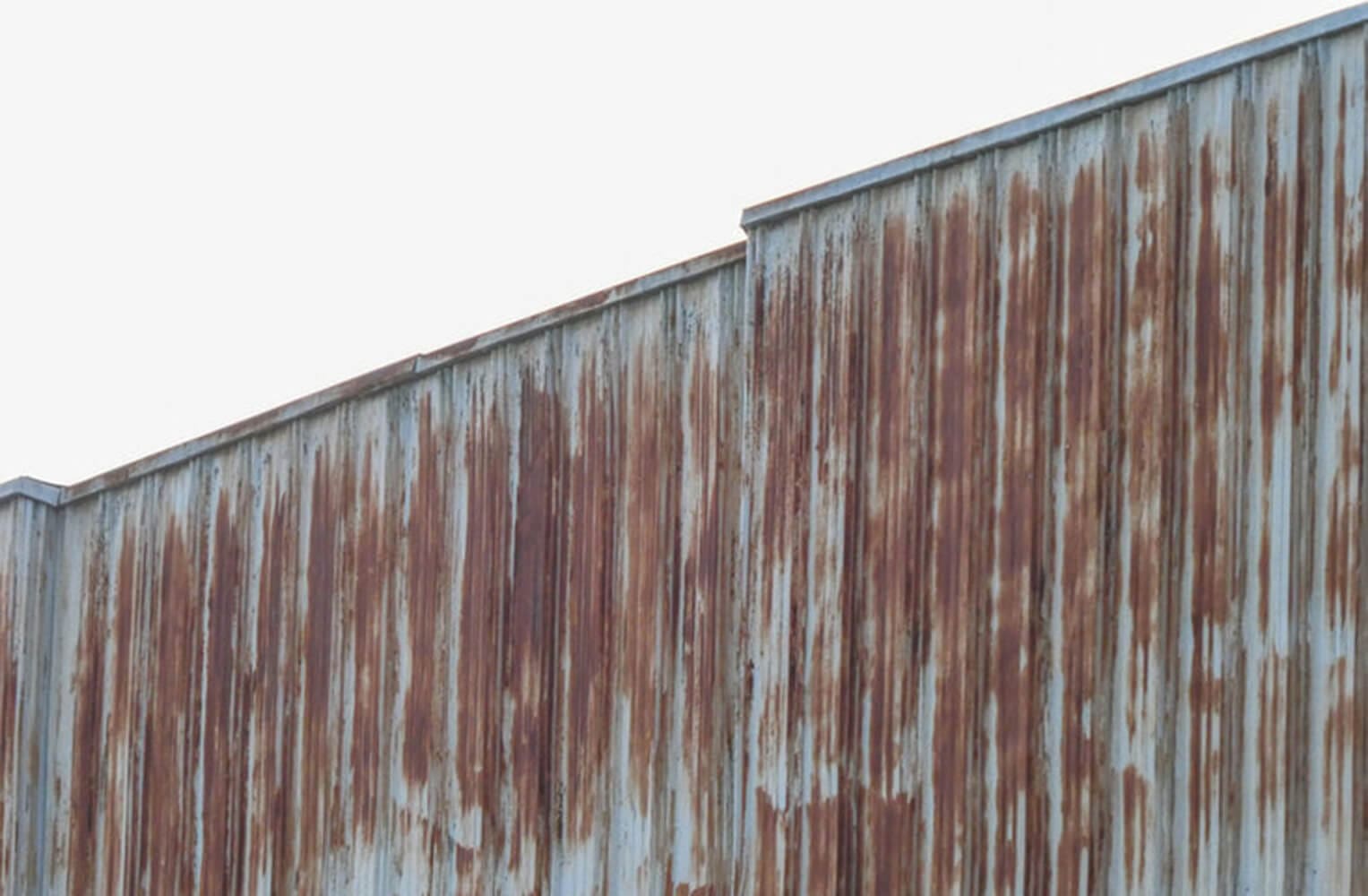
Visible rust on metal siding, structural steel, railings, equipment supports, or overhead structures means the protective coating has failed at those points and moisture has reached the metal. Rust spreads beneath the surface, continuing to oxidize even where the coating still looks intact above it.
The visible rust is typically a fraction of the total affected area. In structural applications, corrosion weakens load-bearing capacity over time. On equipment supports and railings it creates direct safety hazards for employees who contact those surfaces daily. The longer rust treatment is deferred, the more extensive and costly the remediation becomes.
Water Staining, Moisture Infiltration, and Mold
Water stains on interior walls or ceilings, dark streaking, or visible mold growth all indicate moisture is moving through the structure. The coating at those points has failed as a moisture barrier. Mold in an industrial facility is both a health issue and a compliance concern, as it can affect air quality for employees and draw regulatory attention depending on type and concentration.
Moisture infiltration that is visible on interior surfaces has typically been developing for some time before it becomes apparent. The lifespan of any exterior coating is directly tied to how well moisture is kept out from the start. By the time water damage shows on interior surfaces, the damage behind the wall is usually more extensive than it looks from the outside.
Visible Substrate Damage
When the underlying material, whether concrete, masonry, or metal, shows visible deterioration, spalling, pitting, or delamination, the coating has failed long enough for the substrate itself to be damaged. This is the clearest line between a coating problem and a structural problem.
Addressing substrate damage requires repairing the surface before any new coating can be applied. What would have been a straightforward recoat has become a repair-and-recoat project, with a scope and cost that grows the longer it is left.
When a Professional Assessment Is Warranted
Any sign from the active failure or structural risk categories warrants a professional assessment. A visual walkthrough from a facility manager can identify that something is wrong, but it cannot determine how far the failure has spread, what is driving it, or what the substrate condition looks like beneath the surface.
A qualified industrial painting contractor evaluates more than what is visible. They assess coating adhesion, substrate condition, and the environmental factors driving the failure, which determines whether repainting alone is sufficient or whether repairs are needed first.
If your facility is showing early warning signs, the right move is to:
- Document what you are seeing and note when it was first observed
- Track whether the affected areas are expanding over time
- Schedule a professional assessment before the next planned maintenance cycle rather than waiting for the signs to advance
An assessment gives you the information needed to scope the project accurately, budget appropriately, and build the internal case for capital approval if that step is required. The protective value of industrial coatings is only realized when the coating system is maintained before failure has a chance to advance.
What These Signs Are Really Telling You
Coating failure in an industrial facility follows a predictable progression. It starts with surface-level degradation that is easy to defer, advances to active failure where substrate exposure begins, and eventually reaches a point where structural damage has already occurred and the scope of the project has grown significantly beyond what early action would have required.
The earlier in that progression you act, the more control you have over how the project gets handled. A facility showing early warning signs can be worked into a planned maintenance window. A facility showing structural signs requires action on a timeline the damage dictates, not the facility manager.
If you are seeing any of these signs and want an accurate picture of where things stand, contact Weiser Painting Co. to schedule a professional walkthrough and assessment. We serve industrial and commercial facilities throughout Pittsburgh and southwestern Pennsylvania, and we will give you a straightforward answer about what the coating condition means and what it will take to address it.